
Balanced Scorecard for Languages and ROI
Organizations that sponsor language training know exactly how much they invest. What many still ask, however, is a simple question: Are employees actually learning? More importantly, what is the return on that investment (ROI)?
Learning progress can be measured in two distinct ways: through linear assessment, which simply measures improvement over time, or through the BSC-i (Balanced Scorecard for Languages), which measures progress against predefined learning objectives.
Linear Assessment
Linear assessment is the simplest approach. It determines whether an employee has improved between two points in time and may be sufficient when language training is offered solely as an employee benefit, without formal performance objectives.
However, improvement alone does not necessarily mean that learning goals have been achieved. Language proficiency assessments and certificates based solely on linear progression can therefore present an incomplete picture of results.
The following examples illustrate this limitation:
Example 1: An employee is initially assessed at the beginning of the B2 level of the CEFR and, in a subsequent assessment, reaches the upper end of the same level. Has the employee improved? Yes. But was that improvement sufficient to justify the organization’s investment? Without predefined targets, there is no objective answer.
Example 2: An employee’s language proficiency score increases from X to Y points. Has progress been made? Yes. But did the investment generate a positive ROI? Again, without established performance goals, the answer remains unknown.
BSC-l – Balanced Scorecard for Languages
Inspired by the principles of the traditional Balanced Scorecard developed by Professors Robert Kaplan and David Norton of Harvard Business School, BIRD GEI created the Brazilian market’s first BSC-l– Balanced Scorecard for Languages.
The BSC-l establishes individualized learning objectives that enable organizations to accurately measure both learning progress and return on investment through percentage-based performance indicators. Rather than simply reporting improvement, the BSC-i demonstrates whether each employee has achieved the learning targets established at the outset.
Beyond performance measurement, the BSC-l is an effective management, communication, and strategic alignment tool for language training investments. It provides Human Resources and other stakeholders with a clear, objective framework for monitoring results while helping organizations optimize resources and generate long-term cost efficiencies.
ROI – Return on Investment in Language Training
Measuring ROI is far from a new concept. It has been recognized as a business management tool for more than a century. As early as 1920, the Harvard Business Review acknowledged ROI as an effective method for evaluating investment performance.
In recent decades, the concept has expanded to include investments in human capital. According to Jack J. Phillips and Patricia Pulliam Phillips, authors of Show Me the Money, organizations increasingly demand objective evidence that Human Resources initiatives deliver measurable business value, and ROI has become one of the most effective ways to demonstrate that impact.
For an ROI methodology to be practical, it must balance simplicity, credibility, and analytical rigor—precisely the philosophy behind BIRD GEI’s BSC-i.
BSC-l in Practice
The BIRD GEI BSC-l is a corporate language training ROI measurement methodology that integrates:
- Individual learning objectives expressed as percentage-based performance targets
- Language proficiency performance indicators for each employee
- Comparative analysis between actual learning progress and predefined objectives
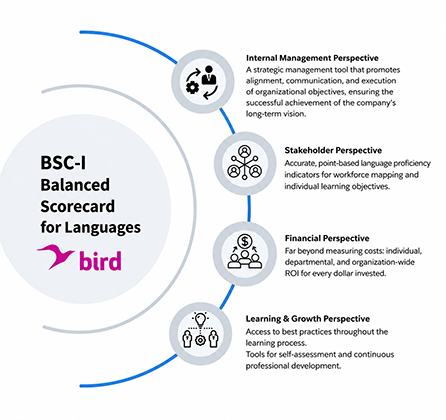
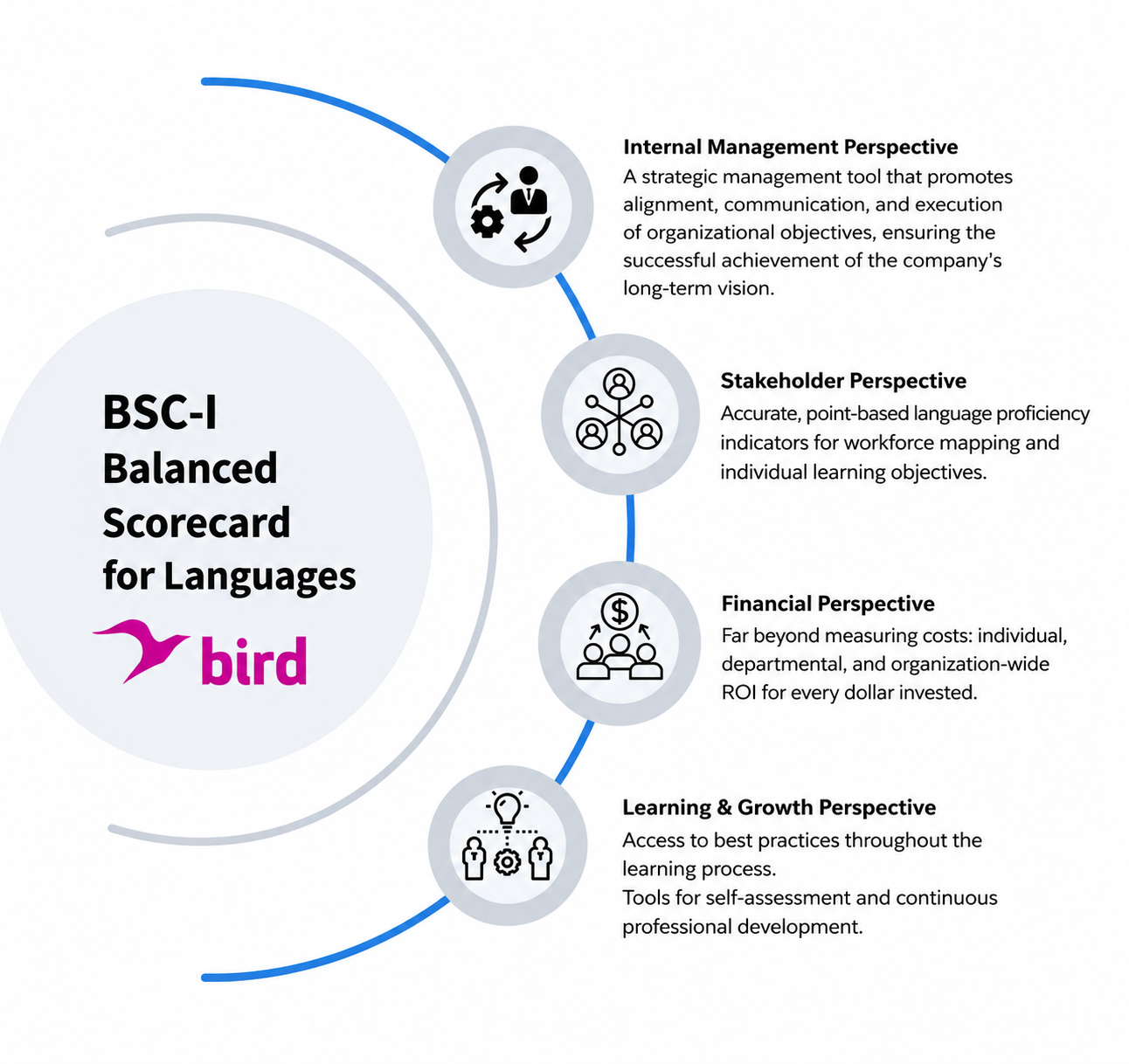
- Four analytical perspectives based on the original Kaplan and Norton Balanced Scorecard framework
- Executive reports that present learning progress and ROI for Human Resources and all relevant stakeholders

