
If you are studying English with a specific goal in mind – going to university abroad, applying for a job, immigrating to another country, or simply proving your level – you may eventually face the same question:
1. Which English proficiency test should I take?
TOEFL, IELTS, TOEIC and Cambridge English are among the best-known international English assessments. But they are not interchangeable. Each was designed with somewhat different purposes, audiences and contexts in mind.
Choosing the right test is therefore not simply a question of which one is “easier” or “better.”
It is a question of what you need the result for.
The best English test is the one accepted by the institution, employer, professional body or government authority you are applying to—and the one that measures the kind of English you actually need.
Let’s look at the main differences.
2. TOEFL, IELTS, TOEIC and Cambridge at a glance
| Test | Mainly associated with | Skills assessed | Scoring |
|---|---|---|---|
| TOEFL iBT | University and academic English | Reading, Listening, Speaking, Writing | 1–6 scale |
| IELTS Academic | Higher education and professional registration | Listening, Reading, Writing, Speaking | 0–9 bands |
| IELTS General Training | Migration, work and non-academic training | Listening, Reading, Writing, Speaking | 0–9 bands |
| TOEIC | Workplace and business English | Listening & Reading; Speaking & Writing available separately | 10–990 for L&R; 0–200 for Speaking and Writing |
| Cambridge English | Long-term English qualifications | Reading, Writing, Listening, Speaking | Cambridge English Scale / CEFR levels |
The important point is that these tests are designed around different purposes. So before choosing one, ask yourself what you need the certificate for.
3. TOEFL iBT: English for academic life
TOEFL stands for Test of English as a Foreign Language. It is administered by ETS and is particularly associated with English used in higher education.
The TOEFL iBT underwent a major redesign on January 21, 2026. If you have studied for the TOEFL in the past, or have seen older descriptions of the test online, be careful: much of that information is now outdated.
The current TOEFL iBT takes approximately two hours and assesses all four skills: Reading, Listening, Writing, and Speaking. The test is adaptive, so the number of items and exact timing can vary.
What does the new TOEFL look like?
The current test includes:
- Reading – tasks such as completing words, reading material from daily life and reading academic passages.
- Listening – responses to questions, conversations, announcements and academic talks.
- Writing – sentence-building, writing an email and participating in an academic discussion.
- Speaking – listening and repeating, followed by an interview.
The test is computer-based and is available at authorized test centres or through the TOEFL iBT Home Edition, which is monitored by a live human proctor.
How is TOEFL scored?
This is another major change.
Since January 2026, TOEFL scores are reported on a 1–6 scale, in half-point increments. Test takers receive scores for each of the four sections as well as an overall score.
During a two-year transition period following the January 2026 change, score reports also include a comparable overall score on the familiar 0–120 scale.
This means that students researching universities may still encounter admission requirements expressed as “TOEFL 90,” “TOEFL 100,” and so on.
Who should consider TOEFL?
TOEFL can be a good choice if your main objective is:
- applying to a university or graduate programme;
- demonstrating academic English proficiency;
- studying in an English-medium academic environment;
- meeting an institution’s English-language requirement.
But always check the specific institution’s requirements before registering. Universities decide which tests and scores they accept.
4. IELTS: English for study, work and migration
IELTS, the International English Language Testing System, is one of the world’s most widely recognised English proficiency tests.
One of its important characteristics is that it offers different versions for different purposes.
IELTS Academic
IELTS Academic is primarily intended for people who want to study at undergraduate or postgraduate level, as well as certain professionals seeking registration in English-speaking environments.
It assesses four skills:
Listening → Reading → Writing → Speaking
The test takes approximately 2 hours and 45 minutes, with the Speaking test lasting 11–14 minutes.
The Academic Writing component has two tasks:
- Task 1: describe visual information such as a graph, chart, table or diagram;
- Task 2: respond to a point of view, argument or problem.
Task 1 requires at least 150 words, while Task 2 requires at least 250 words.
The Speaking test is a face-to-face interview with a certified examiner. It has three parts: an introduction and interview, an individual long turn, and a more general discussion.
IELTS General Training
IELTS General Training is aimed primarily at people who need English for:
- migration;
- work;
- training;
- study below degree level.
Listening and Speaking are the same as in IELTS Academic, while Reading and Writing are different.
The General Training Writing test includes two tasks, but unlike Academic Writing Task 1, the first task involves writing a letter.
How is IELTS scored?
IELTS uses a nine-band scale, from Band 1 to Band 9.
The overall result is reported as a band score, with half-band scores also possible—for example:
5.5 · 6.0 · 6.5 · 7.0 · 7.5 · 8.0
There is no universal “passing score.” The score you need depends on the university, employer, professional organisation or immigration authority concerned.
Who should consider IELTS?
IELTS may be particularly appropriate if you are:
- applying to universities in countries where IELTS is widely accepted;
- seeking professional registration;
- applying for immigration;
- looking for a test with separate Academic and General Training versions.
Again, the decisive factor should be the requirements of the organisation you are applying to.
5. TOEIC: English for the workplace
TOEIC, the Test of English for International Communication, is different from TOEFL and IELTS in an important way.
Its focus is English used in professional and workplace situations.
Rather than primarily asking whether someone can succeed in an academic environment, TOEIC is designed to measure communication skills relevant to the global workplace.
TOEIC Listening & Reading
The TOEIC Listening & Reading test contains:
- 100 Listening questions;
- 100 Reading questions.
The Listening section takes 45 minutes and the Reading section 75 minutes. Including administrative questions, the complete session takes approximately 2.5 hours.
The total score ranges from 10 to 990, with separate scores for Listening and Reading.
The questions use situations and language associated with everyday and professional life.
TOEIC Speaking & Writing
TOEIC also offers separate Speaking and Writing tests.
The Speaking test:
- contains 11 questions;
- takes approximately 20 minutes;
- is scored from 0 to 200.
Speaking and Writing can be taken together or separately.
Together, the TOEIC tests can provide an assessment of all four communication skills.
Who should consider TOEIC?
TOEIC can be particularly relevant if you need to demonstrate English for:
- employment;
- international companies;
- promotion or career development;
- communication with international colleagues or clients;
- workplace training.
Some universities and other organisations also use TOEIC, so once again, check the specific requirement rather than assuming that one test is universally accepted.
6. Cambridge English: a qualification for your level
Cambridge English takes a somewhat different approach.
Instead of having one general-purpose test, Cambridge offers a progression of qualifications aligned with the Common European Framework of Reference for Languages (CEFR).
The main general and higher-education qualifications are:
A2 Key
For learners who can communicate in simple situations.
B1 Preliminary
For learners who have mastered the basics and can communicate in everyday situations.
B2 First
For learners who can communicate confidently in an English-speaking environment.
C1 Advanced
For learners with a high level of English, particularly suitable for academic and professional contexts.
C2 Proficiency
Cambridge’s highest-level qualification, demonstrating exceptional command of English.
You may still encounter the older names KET, PET, FCE, CAE and CPE online. Cambridge has officially changed the names:
- KET → A2 Key
- PET → B1 Preliminary
- FCE → B2 First
- CAE → C1 Advanced
- CPE → C2 Proficiency.
This is worth knowing because older websites, CVs and academic documents may still use the former names.
One important difference
Cambridge English qualifications are designed around a particular CEFR level. This makes them especially useful for people who want to demonstrate where they are on the English-learning scale, rather than simply obtaining a score for a particular application.
Another notable difference is validity: Cambridge states that its exam results and certificates are valid indefinitely. However, an individual university, employer, professional organisation or government authority may impose its own time limit for accepting a certificate.
7. What about the CEFR?
You may have noticed the letters A2, B1, B2, C1 and C2 when researching English proficiency.
These come from the Common European Framework of Reference for Languages, or CEFR.
The CEFR provides a common way of describing language ability across different languages and assessment systems.
Very broadly:
A1–A2 → Basic user
B1–B2 → Independent user
C1–C2 → Proficient user
However, it is important not to assume that scores from different tests are automatically interchangeable.
A TOEFL score, an IELTS band and a Cambridge qualification are produced using different assessment systems. If an institution gives you a required score, use that institution’s published requirement, rather than trying to convert the number yourself.
8. BIRD GEI English Diagnostics: Before Choosing a Test, Know Where You Stand
Knowing which English test to take is only part of the equation.
Before choosing TOEFL, IELTS, TOEIC or Cambridge—or investing in language training—it helps to understand your current English proficiency and where the gaps are.
That is the purpose of a language diagnostic.
An official proficiency test produces a result that can be presented to a university, employer, professional organisation or government authority. A diagnostic has a different purpose: it helps you understand your current capabilities and make better decisions about what comes next.
At BIRD GEI, our English diagnostics look beyond simply assigning a level. They examine how effectively English can be used in relevant situations, helping identify strengths and areas for development.
For professionals, this can include abilities such as listening, speaking, reading, writing, vocabulary and grammar in context, and interaction in professional situations.
For organisations, the diagnostic can provide a broader picture of English proficiency across a workforce, helping identify proficiency gaps and areas that may require attention.
The distinction is important:
A diagnostic tells you where you are. An official test demonstrates where you are.
A BIRD GEI diagnostic does not replace TOEFL, IELTS, TOEIC or Cambridge English when an institution or organisation requires one. Instead, it can help you establish where you are now, define where you need to be, and make more informed decisions about preparation and the test that best matches your objective.
Current capability → Target → Preparation → Official test
9. So, which test should you take?
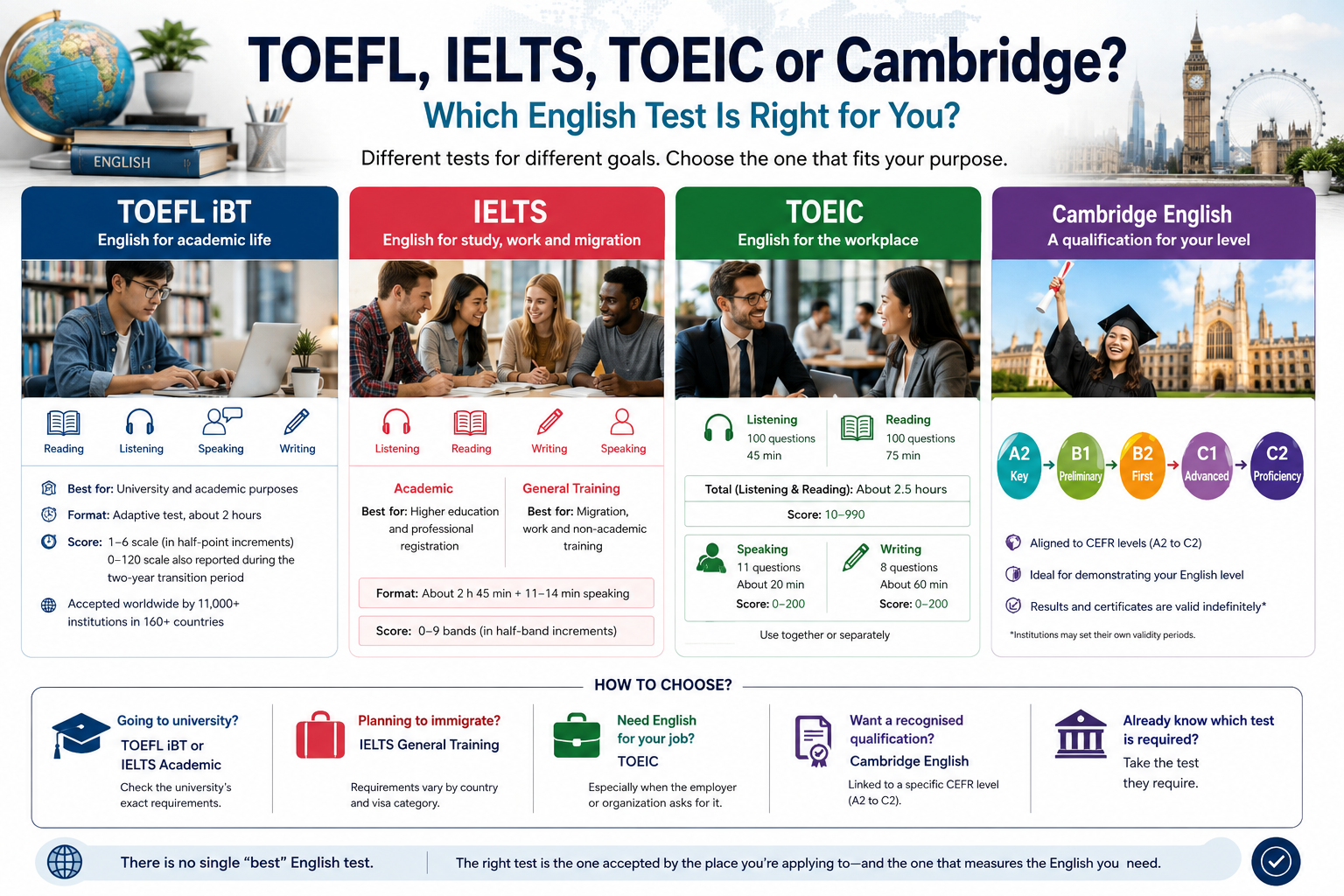
There is no single answer.
Instead, start with your objective.
“I want to study at a university abroad.” Look at: TOEFL iBT or IELTS Academic
Then check the university’s exact requirements.
“I want to immigrate.” Look at: IELTS General Training
But immigration requirements vary considerably by country and visa category, so check the relevant government authority before booking the test.
“I need to demonstrate English for my job.” Consider: TOEIC
particularly when the employer or organisation specifically requests it.
“I want a recognised qualification showing my English level.” Consider: Cambridge English
especially if you want a qualification associated with a specific CEFR level such as B2, C1 or C2.
“My school or university has told me which test to take.” Then the decision is easy: Take the test they require.
Even if another test seems more convenient, a high score on the wrong examination may not satisfy the requirement.
10. One last piece of advice
Before spending money on an English proficiency test, answer these three questions:
1. Why do I need the test?
University? Immigration? Employment? Professional registration? Personal certification?
2. Who will receive the result?
A university, company, government agency, professional body or simply yourself?
3. Which tests and scores do they accept?
This is the most important question of all.
A test is not valuable simply because it is famous. It is valuable because the person or organisation evaluating your English recognises it for your particular purpose.
And remember: a proficiency test is a snapshot of your English ability at a particular moment. Preparing for one can be useful not only because you want the certificate, but because the process itself can help you identify what you need to improve.
At BIRD GEI, we believe that the goal of learning English is not simply to pass a test.
The goal is to be able to use English confidently when it matters.
11. Quick reference
TOEFL iBT → Academic English and higher education
IELTS Academic → Higher education and professional purposes
IELTS General Training → Migration, work and non-academic training
TOEIC → Workplace and professional English
Cambridge English → Qualifications aligned with specific CEFR levels

