Irônico: o CV de Leonardo da Vinci seria rejeitado por um ATS

Esta é a famosa carta de apresentação que Leonardo da Vinci escreveu a Ludovico Sforza, Duque de Milão, por volta de 1482. É frequentemente chamada de seu “currículo” ou carta de candidatura a emprego, e é um dos documentos mais conhecidos na história da engenharia e da arte. A carta está preservada no Codex Atlanticus,… Read More

Ironic: Leonardo da Vinci’s resumé would get rejected by an ATS

This is Leonardo da Vinci’s famous letter of introduction to Ludovico Sforza, Duke of Milan, written around 1482. It’s often called his “resume” or job application letter, and it’s one of the most well-known documents in the history of engineering and art. The letter is preserved in the Codex Atlanticus, the large bound collection of… Read More

Meninas desenvolvem vocabulário maior mais cedo porque falam mais?

Pesquisa mostra que a diferença é real, mas o motivo não é esse. Aos 18 meses, meninas realmente têm vocabulário maior do que meninos, isso está bem medido. A pergunta era por quê, e a suposição mais comum (que meninas simplesmente falam mais, ou recebem mais estímulo verbal dos cuidadores) se mostrou errada. Uma equipe… Read More

Quer que seus filhos aprendam um segundo idioma? Comece por você.

Pesquisa da da Universidade de Cambridge mostra que a disposição dos jovens para estudar um segundo idioma é moldada muito mais pelas atitudes de seus pais do que por seus professores ou amigos. Os autores do estudo argumentam que os esforços para reverter o declínio constante na aprendizagem de línguas devem ter como alvo as… Read More

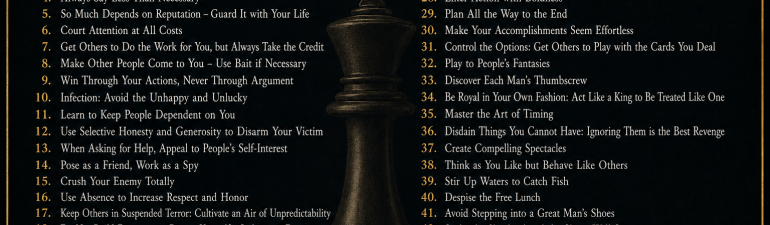
The 48 Laws of Power. To quote Spock “fascinating”!

Nearly three decades after its publication, The 48 Laws of Power remains one of the most discussed—and controversial—books on leadership, influence, and human behavior. The 48 Laws of Power is a 1998 book by Robert Greene and Joost Elffers. The book shares thematic elements with Niccolò Machiavelli’s The Prince and has been compared to Sun-Tzu’s… Read More

What would The Odyssey look like if Odysseus had Google Maps?

Sometimes, technology feels almost too magical. It has become incredibly good at helping us find answers, optimize routes, translate languages, write text, and solve problems. But every now and then, it reminds us of an important lesson: Tools are powerful. Judgment is still human. Behind the humor, there’s a lesson we’ve all experienced at least… Read More

The Universal Language of Music / Música é um Idioma Universal

Music is a Universal Language One of the reasons music connects people across cultures is something surprisingly simple: the pentatonic scale. A pentatonic scale is built with just five notes per octave, yet it appears naturally in musical traditions from every continent. It can be heard in traditional music from China, Japan, Korea, India, Scotland,… Read More

“Tsk” The Unwritten Rules of Languages

We had been living in Istanbul for a short time when my mother decided to visit Hagia Sophia. A block from home there was a taxi stand. We walked over, she opened the door and we all got in. She stated the destination clearly: “Hagia Sophia, lütfen.” She even used the right word in Turkish… Read More

“Tsk” As Regras Não Escritas dos Idiomas

Morávamos em Istanbul há pouco tempo quando minha mãe decidiu nos levar para conhecer a Hagia Sophia. A um quarteirão de casa havia um ponto de táxi. Ela se aproximou, abriu a porta e entramos. Disse claramente o destino: “Hagia Sophia, lütfen.” Até usou a palavra certa em turco para “por favor.” O motorista se… Read More

O que olhos azuis têm a ver com gestão de idiomas?

Estava no elevador de um hotel em Londres com minha mãe quando a porta quase fechou e uma mão apareceu. Entrou um casal de brasileiros em lua de mel, discutindo. Ele a acusava de traição com um amigo. Quando perceberam nossa presença, ela disse baixinho: “fala baixo, eles estão olhando, estão entendendo tudo.” Ele nos… Read More