Do girls develop bigger vocabularies sooner because they’re more talkative?

Research says the gap is real, but the reason isn’t. By 18 months, girls do have measurably bigger vocabularies than boys. That part isn’t disputed. What a team at Duke wanted to know was why, and the common assumption, that girls simply talk more, or get more language exposure from caregivers, turned out to be… Read More

Meninas desenvolvem vocabulário maior mais cedo porque falam mais?

Pesquisa mostra que a diferença é real, mas o motivo não é esse. Aos 18 meses, meninas realmente têm vocabulário maior do que meninos, isso está bem medido. A pergunta era por quê, e a suposição mais comum (que meninas simplesmente falam mais, ou recebem mais estímulo verbal dos cuidadores) se mostrou errada. Uma equipe… Read More

Quer que seus filhos aprendam um segundo idioma? Comece por você.

Pesquisa da da Universidade de Cambridge mostra que a disposição dos jovens para estudar um segundo idioma é moldada muito mais pelas atitudes de seus pais do que por seus professores ou amigos. Os autores do estudo argumentam que os esforços para reverter o declínio constante na aprendizagem de línguas devem ter como alvo as… Read More

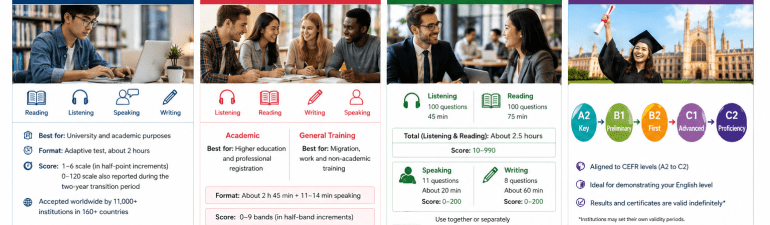
TOEFL, IELTS, TOEIC ou Cambridge? Qual certificado de inglês é o certo para você?

Se você está estudando inglês com um objetivo específico em mente, seja uma universidade no exterior, se candidatar a uma vaga de emprego, imigrar para outro país ou simplesmente comprovar seu nível, é provável que em algum momento você se depare com a mesma pergunta:   1. Qual teste de proficiência em inglês eu devo fazer?… Read More

TOEFL, IELTS, TOEIC or Cambridge? Which English Certificate Is Right for You?

If you are studying English with a specific goal in mind – going to university abroad, applying for a job, immigrating to another country, or simply proving your level – you may eventually face the same question: 1. Which English proficiency test should I take? TOEFL, IELTS, TOEIC and Cambridge English are among the best-known… Read More

Confusing words: Overtake Takeover Take Over

o·ver·take, oʊ vərˈteɪk/ Show Spelled [oh-ver-teyk] verb, -took, -tak·en, -tak·ing. verb (used with object) 1. to catch up with in traveling or pursuit; draw even with: By taking a cab to the next town, we managed to overtake and board the train. 2. to catch up with and pass, as in a race; move by:… Read More

Is the Em Dash Really an AI Giveaway?

One of the most common claims circulating online is that the use of the em dash (—) is a telltale sign of AI-generated writing. Not quite. The em dash wasn’t invented by AI. It has been part of English typography for centuries and has long been used by professional writers, editors, journalists, and publishers to… Read More

Confusing words: Everyday and Every day

Everyday Everyday is an adjective that means commonplace, ordinary, or normal. ~ These shoes are great for everyday wear ~ You shouldn’t wear an everyday outfit to the wedding ~ Don’t use the everyday dishes – it’s a special occasion Every day Every day means “each day.” ~ I go to the park every day… Read More

Terceirizaram a execução. Mas quem ficou com a responsabilidade pelo resultado?

Eu tinha uns treze anos quando levei nosso cachorro, Walker, para passear num parque perto de casa em Basiléia, Suíça. Ele parou na entrada e fez as necessidades no lugar errado. Do nada apareceu um policial e começou a falar comigo em alemão. Eu disse, em inglês, que não falava alemão. Ele trocou para o… Read More

They outsourced the execution. But who kept responsibility for the results?

I was about thirteen when I took our dog, Walker, for a walk in a park near our home in Basel, Switzerland. He stopped at the entrance and did his business in the wrong place. Out of nowhere, a police officer appeared and started speaking to me in German. I said, in English, that I… Read More