Sonder
Aprendizado de idiomas, cérebro bilíngue e educação bilíngue
A BIRD GEI | Consultoria e Gestão de Idiomas está divulgando a 10ª Pesquisa de Produtividade no Aprendizado de Idiomas no Brasil. Acompanhamos anualmente o desempenho, indicadores e resultados de aproximadamente 4.000 funcionários patrocinados pelas mais diversas empresas, mapeando e quantificando o aproveitamento e a produtividade dos alunos. Na pesquisa atual, que abrange o ano de 2014,… Read More
BIRD GEI | Consultoria e Gestão de Idiomas is releasing its 10th Productivity Research in Language Acquisition in the Brazilian market. We follow the annual performance indicators and test results of approximately 4.000 employees sponsored by several companies, mapping and quantifying the progress and productivity of students. In the current research, which covers results from 2014,… Read More
1. Om nom An onomatopoeical adjective based on the sound emitted when something is “oh so tasty” (either through hunger or flavorological value) that one gnaws through it without regard to cleanliness or etiquette. This sort of ravenous eating will often result in an “om nom nom nom” noise being emitted from the eater. Arthur:… Read More
A multi-word verb is a verb that has more than one word. We usually think of them as a main verb followed by one or two particles. The particle could be an adverb or a preposition. I never messed around at school, I was a good student. (to mess around = to behave badly) Multi-word… Read More
“Jealousy is when you worry someone will take what you have. Envy is wanting what somenone else has.” – Homer Simpson It’s no fun to feel envy or jealousy because both make you feel inadequate. Envy is when you want what someone else has, but jealousy is when you’re worried someone’s trying to take what you have. If you want your neighbor’s new… Read More
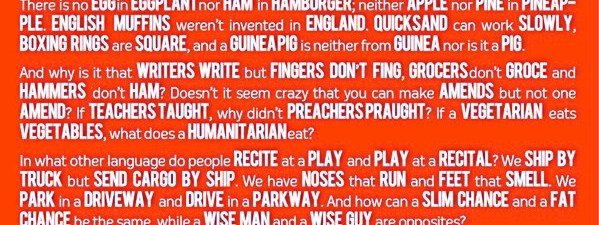
The pun, also called paronomasia, is a form of word play which suggests two or more meanings, by exploiting multiple meanings of words, or of similar-sounding words, for an intended humorous or rhetorical effect.These ambiguities can arise from the intentional use and abuse of homophonic, homographic, metonymic, or metaphorical language. A pun differs from a… Read More
A BIRD GEI | Consultoria e Gestão de Idiomas publicou a 6a Pesquisa de Produtividade em Aquisição de Língua Estrangeira em novembro de 2010. Nós comparamos a eficiência de cursos de idiomas online vs. presenciais. Esta pesquisa foi a primeira de seu tipo no Brasil, porque mostrou a produtividade e os indicadores de evolução de aprendizagem e não… Read More
A lot of people are mixing up lose and loose. In particular, a lot of people are writing loose when they really mean lose. Here are the definitions of the two words from my Penguin dictionary: loose [lOOs] adj not fastened or pre-packed; not tied up or confined; able to move freely; not tight, not… Read More